Why Scrum Masters Are Sinking Their Own Careers (And the AI Rescue Boat to Board This Monday)
You’re not losing your job to AI; you’re losing it to administrative bloat. Here is the protocol to automate the 'machine work' and reclaim 15 hours a week.

You fear the wrong iceberg.
Across the Agile community, Scrum Masters look at generative AI and see the glacier that will destroy their careers. But the real threat is different. We are actively drowning in a freezing undercurrent of administrative bloat, tool-juggling, and meeting scheduling that we confront every single day.
Organizations think they are saving money by assigning one coach to four teams. But they are just buying a captain who cannot see the horizon because they are busy polishing the deck chairs. They are wrong. AI is the vessel that can save us from this freezing water, not the iceberg sinking our ship.
The Cost of Colliding with the Context Tax
I learned this the hard way.
Looking back on my career, I remember supporting four teams at once. My calendar was a chaotic Tetris grid of overlapping events. I spent my days copying text between Jira, Google Sheets, and emails. I was a glorified secretary. During one sprint, a team mentioned a blocked deployment pipeline on Monday morning. I offered to help facilitate not just the symptom, but the root cause of the problem. But I was so busy attending scheduled meetings and compiling Jira data that I didn't open the dependency block until Thursday afternoon. The ship had already sunk. The sprint derailed.
When a coach is drowning in this administrative ocean, the organization pays a massive, invisible price. This is the Context Tax. In my experience, it manifests as a brutal 15 to 20 percent loss in delivery velocity. Blocked items sit two to three times longer, stakeholders demand rework because reports are misaligned, and conflicts that should be spotted on day one boil over on day eight. We trade context for compliance. We abandon empiricism and flow metrics.
The Administrative Iceberg: Why We Are Sinking Our Own Ships
The cognitive math is brutal.
Systems thinker Gerald Weinberg established the rule years ago: working across two simultaneous contexts cuts productivity by 20 percent. Supporting three contexts results in a 50 percent loss. Working across five contexts? You lose 75 percent of your time. Every switch between teams is a collision. Researchers at UC Irvine found it takes an average of 23 minutes and 15 seconds to regain focus after an interruption. You cannot navigate a ship when interruptions constantly shatter your focus.
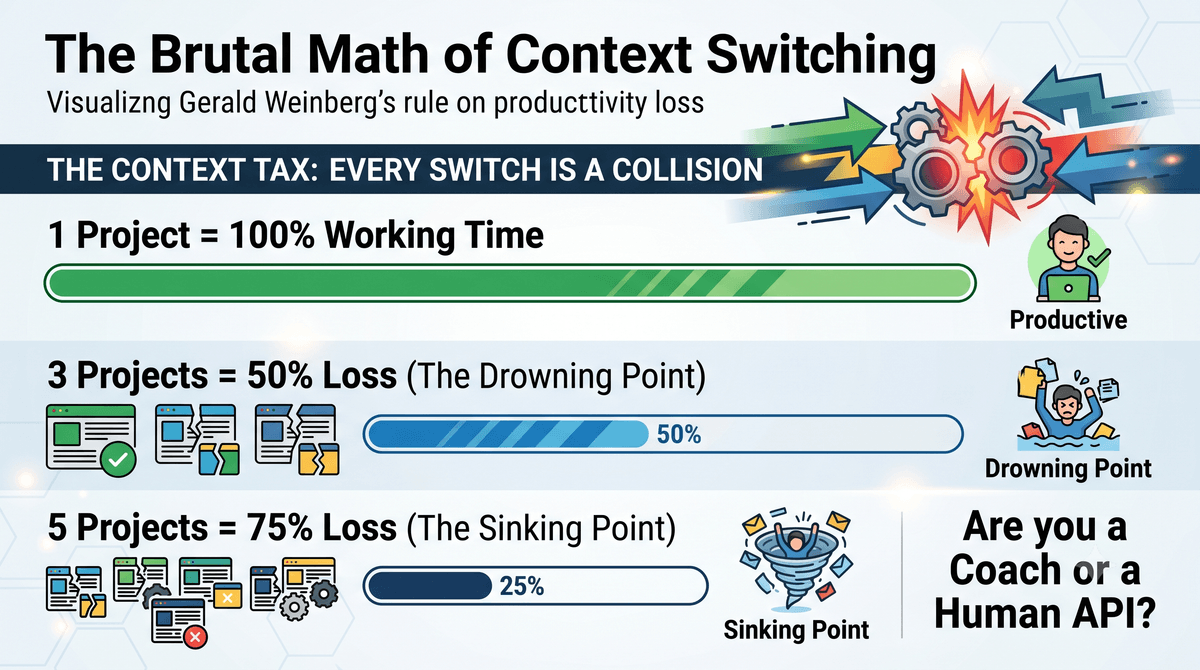
Knowledge workers toggle between applications and websites nearly 1,200 times per day. This leak drains hours from the day. We lose roughly four hours a week just reorienting. According to the 18th State of Agile Report, 43 percent of organizations struggle with inconsistent processes, and 41 percent cite a lack of visibility. We try to solve this with status updates. This leads to Data Work Theater. We manually export data from Jira to Excel, paste it into our favorite LLM, and wordsmith the result to sound less robotic. You are a human API. Christiaan Verwijs calls this Zombie Scrum with better grammar.
This theater is especially dangerous because developers are shipping code faster than ever. A 2025 study by METR found that developers using AI took 19 percent longer to complete tasks, yet believed they were 20 percent faster. They feel fast. They are wrong. Thoughtworks analyzed enterprise delivery and found that while AI makes coding 30 percent faster, the net delivery improvement for the full software lifecycle is a marginal 8 to 15 percent.
It is like giving a Level 1 player a Master Sword in Zelda but leaving their Max HP at 10. They swing for massive damage. One mistake wipes the party. As a coach, your role is to protect the team's Max HP. You are the whistleblower.
You cannot protect the team's health when you are drowning in the freezing ocean of administrative task-switching.
Our current organizational model increases extraneous load, which leaves zero working memory for the actual complex human dynamics of our teams. We must shed weight.
Boarding the AI Rescue Boat: The Automated Lookout Protocol
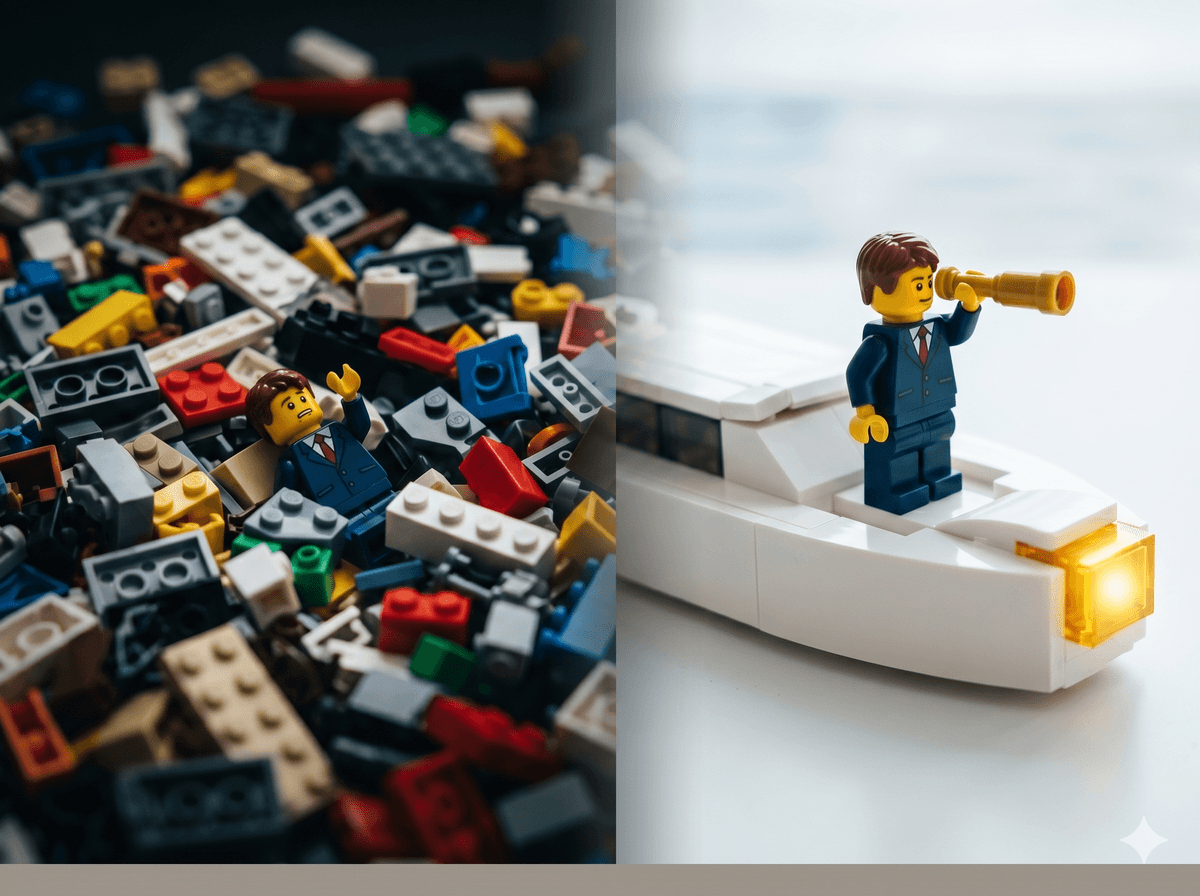
We must board the boat.
AI handles mechanics. Humans handle context. We must build persistent systems that protect our attention rather than typing queries into simple chat windows that require constant manual copying. I'm a self-proclaimed lazy Scrum Master: I refuse to do work a computer should handle. Here is the protocol to automate the admin weight and stay afloat.
Step 1: Intake and Triage: Setting the Automatic Lookouts
You cannot manually inspect every ticket without losing your focus. Save your energy. Configure this system prompt in your project tool's virtual assistant or custom agent to scan your board automatically every day:
You are an autonomous Context Protector agent for a Scrum Master supporting [NUMBER] teams. Your goal is to eliminate extraneous cognitive load so the human can focus on team dynamics.

Run this analysis daily at [TIME] against the current sprint board for [TEAM NAME]:

1. Triage: Identify any ticket that has remained in "In Progress" or "Blocked" for more than 48 hours without a comment update.
2. Synthesis: Cross-reference these stalled tickets against the team's historical cycle time.
3. Output: Generate a 3-bullet brief highlighting ONLY systemic anomalies. Do not summarize work that is flowing normally. Flag specific dependencies that are causing the delay.

Format the output as a direct question the Scrum Master should ask the team, based on the data.
Step 2: Meeting Transcription: Reading the Undercurrents
Do not take meeting notes. Be present. Instead, run a transcription tool and feed the output to an assistant that can analyze the complex undercurrents of the conversation.
Use this prompt. Feed your retrospective transcript into it to identify the hidden friction points that occurred during the session and map your coaching actions:
You are analyzing the transcript of a team event. I am the Scrum Master who facilitated it.

Do not give me a summary of what was said. I was there.

Instead, analyze the transcript for:
1. Voices not heard: Who spoke for less than 5% of the time?
2. Deflection patterns: When a systemic issue was raised, how quickly did the conversation pivot to a tactical fix?
3. Unresolved tension: Identify any moment where a team member expressed frustration that was not addressed by the group.

Give me the raw data so I can design my coaching approach for the next sprint.
Charting a Course to High-Status Delivery Leadership
Once you let the machines do the machine work, you will reclaim ten to fifteen hours a week. Do not schedule more meetings. You must pivot that capacity immediately to actual delivery leadership, focusing on the systemic blockers that actually slow your teams down.
This means hunting down the shared deployment pipeline failing 15% of its builds, mapping its impact on lead time, and presenting the hard data to engineering leadership to fix it. Run strategic workshops to ensure the product vision maps to daily work. Spend one-on-one time mentoring emerging engineering leads who struggle to transition from writing code to leading humans. Focus on what matters.
What AI cannot do is sense burnout from body language. It cannot navigate interpersonal conflict. The Scrum Masters at risk are the ones who remain in purely administrative roles, polishing deck chairs on a sinking ship. The coaches who board the rescue boat and redirect their capacity toward measurable impact become indispensable.
This is why administrative bloat isn't just annoying it is an ever-present threat to Agile coaching, because a coach who cannot see the horizon is useless to their team and to their org. Do not drown. Once you board the rescue boat, you will see the horizon again.
Your move.
Try this Monday: Automate one administrative task. Use your meeting transcription to summarize a daily, or employ a simple virtual assistant to triage stalled tickets on your board. Reclaim thirty minutes. Spend it on the coaching work a machine cannot touch.
Continue Your Journey
AI Development for Non-Technical Builders: Stop wasting hours copy-pasting data between windows and learn how to build the persistent AI agents that actually protect your context.
Monte Carlo Forecasting Calculator: Get a probabilistic forecast for your project in seconds using actual historical throughput data instead of false precision.