The Vibe Coding Addiction: Why Your "1% Improvements" Are Killing Your Delivery
Vibe coding feels like velocity, but it's often just expensive dopamine. Learn how to break the infinite AI iteration loop and start shipping real value.

I flushed eleven hours down the toilet last week. I didn't spend them in the garden or watching a movie with my family. I spent them "vibe coding" a tool that was perfectly fine on Monday morning. I was deep in the flow. The code was flying off the screen. I felt like a god.
The outcome? I shipped exactly zero value.
The story of my Tuesday is one where a false sense of velocity masked a delivery crisis. We’ve spent years in the agile trenches trying to kill the friction between an idea and a customer interaction. We shortened the feedback loops. We automated the pipelines. We handed out LLM co-pilots like candy to make the "doing" effortless.
We didn't build a delivery engine. We built the world's most expensive dopamine loop.
The most important thing you can do as a leader is help practitioners recognize their Definition of Done and know when to walk away. In a world where the cost of software development is crashing toward zero, the industry calls this "vibe coding." It’s the act of rapidly generating and iterating on an app using AI without a clear stopping point. It feels amazing. It is also destroying your cycle time.
The Cost of Infinite Iteration
Let’s look at the data. 25% of Y Combinator's Winter 2025 startups are running on codebases written almost entirely by AI. These founders talk about "speed and efficiency" like it's a religious text. They are compressing development timelines from weeks into hours.
That looks like a massive victory for flow metrics. It isn't. It’s an illusion. It is the same trap I warned about in The Scrum Master Credibility Crisis—prioritizing the appearance of activity over the reality of outcomes.
What those speed metrics fail to capture is the downstream cost of frictionless generation. Dave Laribee calls this the accumulation of learning debt. We generate code so fast that we outpace our own ability to actually understand the system. We get the artifact, but we miss the insight. You can generate 1,000 lines of code in ten seconds, but you'll spend four hours untangling the unnecessary complexity later. That’s negative throughput.
This isn't just a solo-founder problem. I see "vibe coding" in Series C fintechs where teams use Copilot to "refactor" working code until it’s a beautiful, unmaintainable mess of patterns nobody asked for. Practitioners will tell you TDD solves this. They’re right, but in a vibe-coding loop, you’re prompting the tests too. You’re just hallucinating at a higher level of abstraction. You still need the circuit breaker.
My cycle time for that tool had spiked 400%. I was focused on getting the current tool perfect instead of good enough. The repository showed 47 commits in two days for a dashboard that still didn't help my teams any better than the version I had on Monday morning.
Individual builders get hooked on the dopamine hit of seeing things appear on screen. It’s like grinding level-one slimes in an RPG when the final boss is already waiting for you in the next zone. You feel like you're leveling up, but you're just wasting mana on things that don't move the quest forward.
That's theater. It is motion disguised as progress.
The IDE Confession
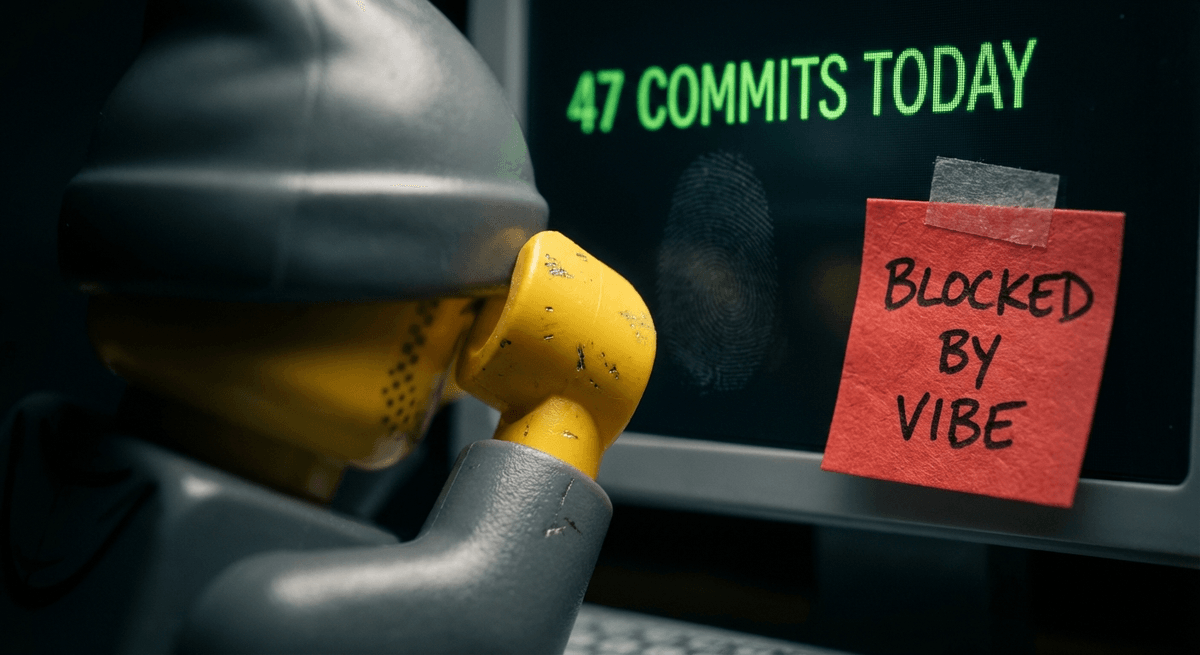
I should have known better. Looking back, I actually fought this exact addiction last year.
I have been building a custom Python app to automate flow metrics for my coaching sessions. (Full disclosure: This app was mostly regex and spite, but it worked.) Because the script lived in an open IDE on my desktop, there was zero friction to changing it. Every time I ran the tool to help a team, I would notice a tiny "improvement" I could make.
I spent more time optimizing the tool than I did coaching the humans the tool was meant to serve. I was avoiding the hard work of coaching by hiding behind the easy dopamine of frictionless code changes. I’d fallen into the exact opposite of the mindset I shared in The Lazy Scrum Master’s Guide to True Leadership, where the goal is doing less of the wrong thing to make space for the right thing.
I had to sabotage my own environment.
I deleted the IDE shortcut from my desktop, the taskbar, and the start menu pins. Now I had to hunt for it. I had to manually search for the application, navigate the file system, and reopen the environment. That tiny bit of friction was the circuit breaker. I had to ask myself if the change was actually worth the walk. It rarely was.
I don't trust myself in a frictionless room. Give me a "perfect" IDE and I'll spend three days rearranging the deck chairs on the Titanic while the team waits for a forecast. It is for this reason that I don't let frictionless environments keep me in my own feedback loop. A legacy codebase slows you down. A frictionless environment tricks you into thinking you are going fast while you drive straight off a cliff.
How to Break the Vibe Coding Loop
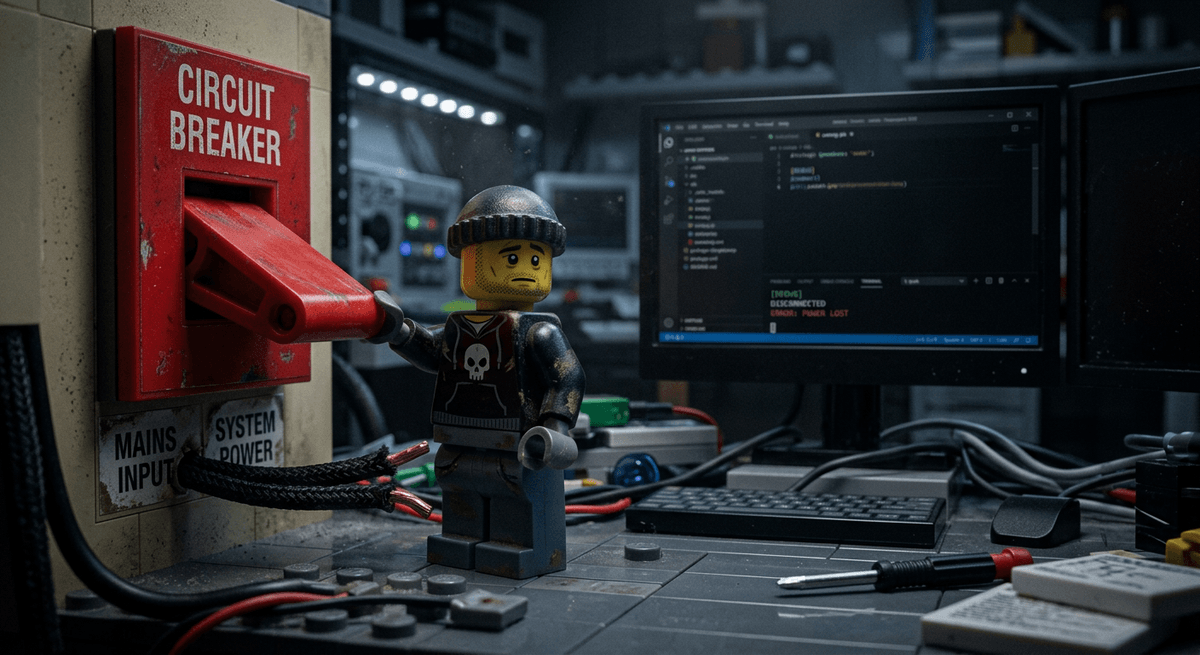
Y'all cannot solve a behavioral addiction by continuing to iterate. If you are a fellow vibe coder building tools for your organization, you have to change your own choice architecture. You must introduce checkpoints that force you out of the dopamine loop and back into a delivery mindset.
1. Write Backlog Items for Yourself
Stop coding the moment you have an idea. If I think of a "1% improvement," I no longer give myself permission to prompt it immediately. I have to write it down as a formal backlog item. Use the LLM to draft the acceptance criteria instead of generating more code. It forces me to articulate the value. Usually, once I see the "feature" written out, I realize it’s just gold-plating.
2. Define "Good Enough" Before Opening the IDE
Write down exactly what success looks like. If the tool hits the goal, the session is over. Close the laptop.
3. The Calendar Circuit-Breaker
Don't just say you'll spend an hour. Actually block out that timebox on your calendar. When that block is expired, you commit your code and move on. Period. I’ve watched teams lose entire afternoons because they thought they were "almost there" with a CSS tweak. The circuit breaker is the only thing that stops the "just one more prompt" cycle from eating your capacity for the work that actually matters.
Coaching the Team:
You can use these same principles with your teams. When you see a developer or a squad getting stuck in "perfectionist loops," use these as coaching prompts. Ask them: "What was the original success criteria for this session?" or "If we had to ship this in 10 minutes, what would we cut?" Bring them back to the mission.
The Monday Dare
We’ve been sold a lie that any friction in our workflow is a bug. It’s not. It’s about the danger of including so much knowledge and context in your IDE that you forget the mission. You're no longer building a solution; you're just feeding a machine.
Without a clear stopping point, you’re just hydroplaning on your own excitement.
Take that tool or feature you've been "polishing" for the last three days. On Monday morning, look at the very first version that actually worked. Ask yourself: Does this version meet the Definition of Done? If the answer is yes, stop. Close the IDE. Go talk to the humans your tool is supposed to serve.
Watch what happens. You will feel a pull to go back and fix one more thing. Resist it.
And for the first time in weeks, you will actually ship something that works.
Stop iterating. Start shipping.
Your move.
Continue Your Journey AI Development for Non-Technical Builders: Learn how to build real tools with AI without falling into the vibe coding trap — structured delivery from idea to working product.
Monte Carlo Forecasting Calculator: Stop guessing when you'll ship. Use probabilistic forecasting to set realistic expectations and actually hit your delivery targets.